
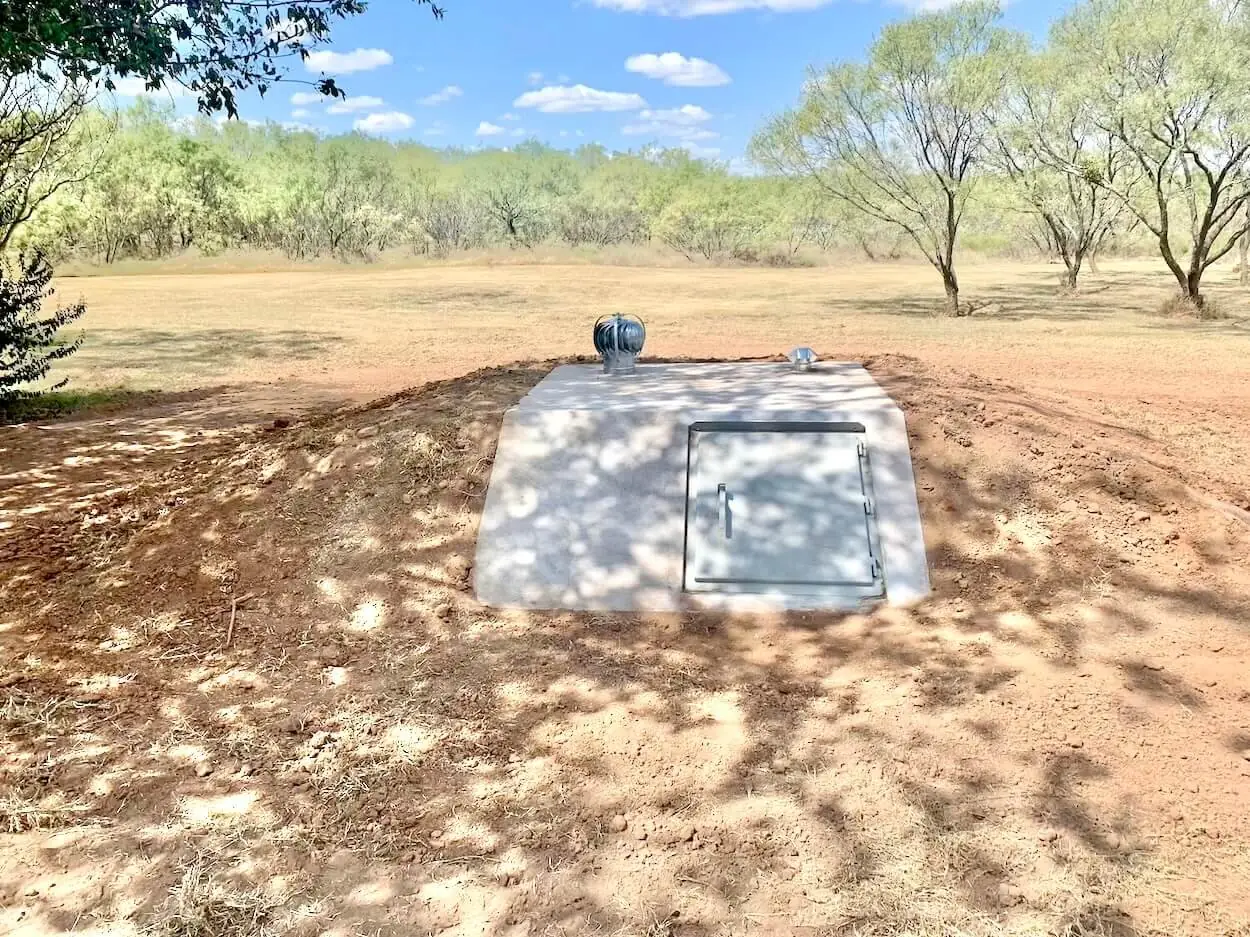
How Much Does a Storm Shelter Cost in Oklahoma?
A 2026 national cost guide puts an in-ground or underground storm shelter at $4,000 to $20,000. Some installs climb even higher. The same guide lists $10,000 to $15,000 for a shelter sunk below a garage floor. A shelter that stays above ground runs $2,600 to $15,000.
That guide says most homeowners pay $3,000 to $13,000, and it puts the national average at $7,500. These are market numbers, not our price list. Eastern Oklahoma Septic Services installs in-ground storm shelters around Sapulpa and the Tulsa area. We look at the job and put the quote in writing.
What do national cost guides say each type of shelter costs?
Cost guides price a shelter by its type and by where it sits. The 2026 rows below come from a national cost guide built on contractor estimates. The 2022 rows come from an older national cost guide. One row comes from a national home improvement guide that gives no date.
| Shelter type | Published range | Kind of source |
|---|---|---|
| In-ground or underground shelter | $4,000 to $20,000 | National cost guide, 2026 |
| In-ground shelter, top of the range | Up to $30,000 | National home improvement guide |
| Garage shelter sunk below the floor | $10,000 to $15,000 | National cost guide, 2026 |
| Garage shelter set on the slab | $3,000 to $9,000 | National cost guide, 2026 |
| Shelter in or on a garage floor | $5,600 to $7,500 | National cost guide, 2022 |
| Above-ground shelter | $2,600 to $15,000 | National cost guide, 2026 |
| Above-ground shelter | $2,800 to $15,500 | National cost guide, 2022 |
| Safe room bolted to a floor or slab | $3,000 to $12,000 | National cost guide, 2026 |
The 2022 guide says an above-ground shelter usually costs less than an underground one. The 2026 numbers start lower above ground too. A safe room bolted to a slab needs no hole in the yard. An in-ground shelter is mostly a digging job.
What drives the price of an in-ground storm shelter?
- Size. A shelter that holds more people is a bigger unit set in a bigger hole.
- Steel or concrete. Both cost guides put a concrete shelter at $3,500 to $8,000. For steel, the 2022 guide lists $4,450 to $10,000, and the 2026 guide lists $4,500 to $20,000.
- Rock and water in the dig. Rock near the surface or water in the hole adds work. NRCS soil data shows both around Sapulpa. Dennis soils hold a perched water table 12 to 30 inches down from December to April. Bigheart soils sit on sandstone 10 to 20 inches down.
- Digging the hole. The 2022 guide says preparing the ground and digging are often left out of a shelter’s price. It lists $1,000 to $4,000 for that work.
- Room for the equipment. A tight gate or a long carry across the yard adds work. The 2026 guide lists trucking and crane time at $1,000 to $3,000 when a contractor bills it separately.
- The OKIE811 call. Oklahoma law requires notice to OKIE811 at least 48 hours before digging. The day of the call, weekends and legal holidays do not count. Septic lines are private, so the utilities do not mark them. OKIE811 says property owners pay to locate and protect private lines.
- The permit. Some areas require a building permit for a storm shelter. Ask your city what it requires and what it costs before the install date.
- The door and the anchoring. FEMA P-320 is the federal safe room guide, and ICC 500 is the national storm shelter standard. FEMA calls anchoring critical to how a factory-built shelter holds up in extreme wind. Ask which standard a shelter meets before you compare prices.
Does the SoonerSafe rebate lower the cost in 2026?
No. Oklahoma’s SoonerSafe Safe Room Rebate Program is not open for 2026. No one should plan on a rebate this year.
When the program runs, its rules cap the rebate at $3,000 per home. The rebate also cannot exceed 75 percent of the actual cost. Homeowners register at soonersafe.ok.gov, and recipients are picked at random.
Do you need a permit or a registration for a storm shelter?
Permit rules change at the city line. Jenks requires a permit for every outdoor storm shelter, and the shelter must meet FEMA P-320 or ICC 500. Creek County says it is not issuing building permits or doing inspections in unincorporated areas. Inside any other city, ask the permit office before the install date.
Registration comes after the install. The Sapulpa Fire Department keeps an online Safe Room and Storm Shelter Registration. Creek County Emergency Management has a Safe Room Registration Form for the county. Tulsa homeowners inside city limits register by dialing 311. Broken Arrow, Bixby and Glenpool keep their own lists.
Why do so many Oklahoma homes add a storm shelter?
Oklahoma averages 59.4 tornadoes a year, by National Weather Service counts from 1950 through 2025. May is the peak month, with 24.4 tornadoes on average. A shelter close to the house gives a household somewhere to go when a warning sounds.
How far should a storm shelter sit from a septic system?
On a septic lot, the shelter dig has to miss the system. That means the tank, the lateral lines and, on an aerobic system, the spray area. Oklahoma’s septic rules keep a tank and the lateral lines at least 5 feet from a building. Lateral lines also stay 5 feet from driveways and paved areas. Give a storm shelter at least that much room.
The state rule requires a spray field to be planted or terraced to prevent runoff. Keep the shelter and its door out of that ground.
Find the parts before you pick the spot. DEQ’s homeowner guide says a system’s original inspection report should show where the tank and the field are. If you do not have a copy, you can get one at your local DEQ office.
On a new build, lay out the shelter and the new septic system installation at the same time. If the lot has an aerobic septic system, mark the spray heads before you choose the spot. When we set an in-ground shelter, we place it clear of the tank, the lateral lines and the spray area.
How do you get a real number for an in-ground shelter?
National ranges help you plan, but your yard sets the real number. Soil and access change the work from one yard to the next. Our storm shelter installation page covers the dig, the set, the backfill and the grading. Call or text (918) 645-0557, and we look at the job and put the quote in writing.