
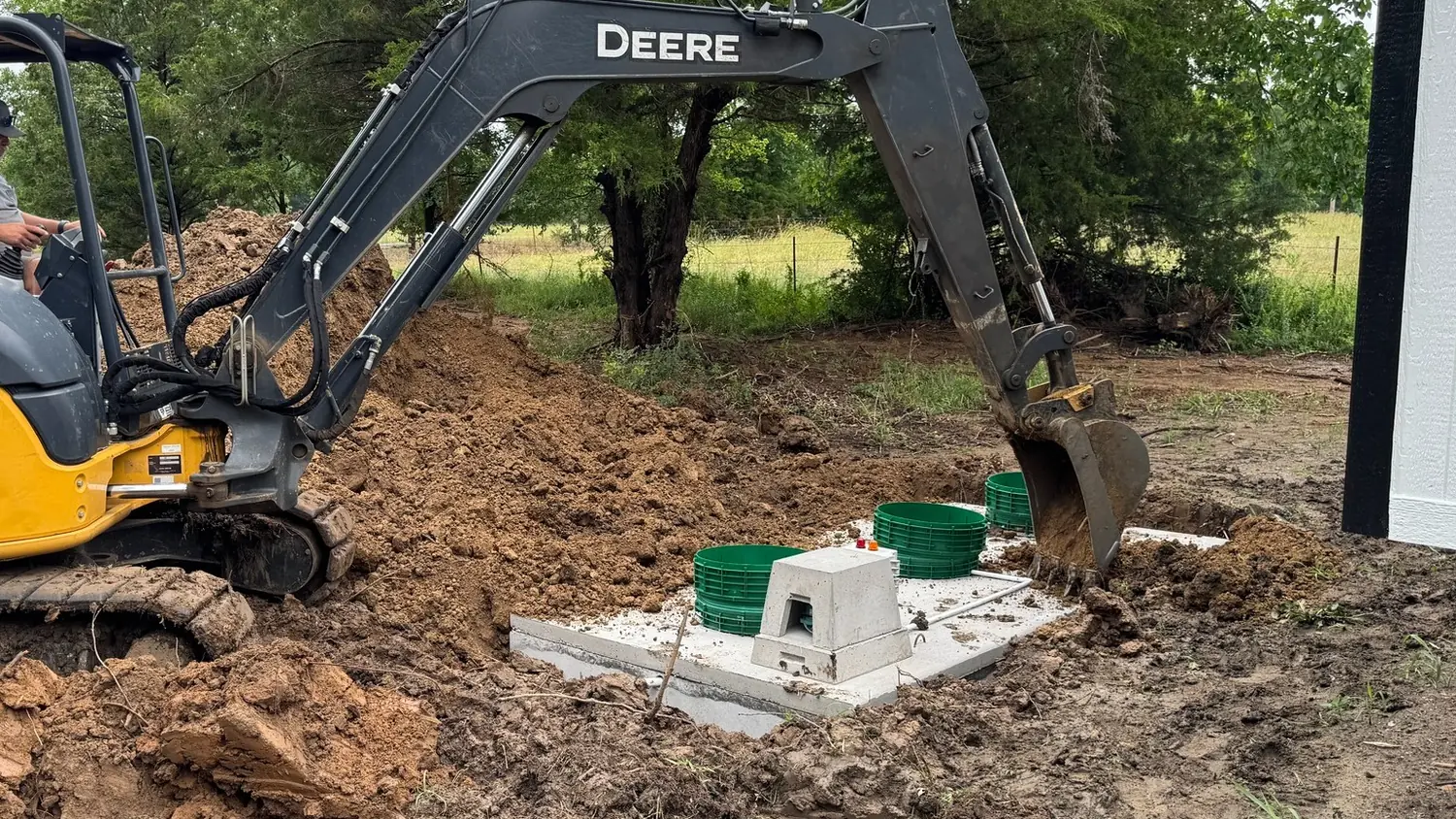
How Much Does a New Septic System Cost in Oklahoma?
National cost guides put a new septic system at about $3,500 to $12,500 in 2026. The national average in one guide is $8,016. A conventional system runs $3,000 to $8,000 in the same guides. That system is a septic tank plus lateral lines, the Oklahoma name for a drain field or leach field.
In Oklahoma, the state’s soil test and permit add a few hundred dollars each. These are market numbers, not our price list. The real figure for a lot comes from its soil report and its layout. Our septic system installation page explains how the work runs from soil test to final inspection.
What does each part of a new septic system cost?
National guides say labor makes up 50 to 70 percent of the total. The DEQ rows come from the state’s schedule for July 2026 to June 2027.
| Item | Published range | Kind of source |
|---|---|---|
| New septic system, installed | $3,590 to $12,463 | National cost guides |
| Conventional system, tank and lateral lines | $3,000 to $8,000 | National cost guides |
| 1,000-gallon tank, tank only | $900 to $1,500 | National cost guides |
| 1,500-gallon tank, tank only | $1,500 to $2,500 | National cost guides |
| New lateral lines (drain field) | $5,000 to $12,000 | National cost guides |
| Digging, when billed on its own | $1,500 to $6,300 | National cost guides |
| Soil or percolation test | $700 to $2,000 | National cost guides |
| DEQ soil test | $214.36 to $357.28 | Oklahoma DEQ fee schedule |
| DEQ Authorization to Construct, home system | $357.28 to $500.19 | Oklahoma DEQ fee schedule |
| Aerobic system, for comparison | $10,000 to $20,000 | National cost guides |
A 2022 Oklahoma public radio report put a typical new install at $6,000 to $8,000. The aerobic row gets its own page in the aerobic system cost guide.
How does tank size change the price?
Oklahoma’s rule sets the minimum tank by bedrooms. A home with four or fewer bedrooms needs a tank of at least 1,000 gallons. Each bedroom past four adds 250 gallons, so a five-bedroom home needs 1,250 gallons. The DEQ’s homeowner guide suggests a tank 20 percent larger if you plan to run a garbage disposal.
Tank size moves the total less than the lateral lines do. In national guides, a 1,000-gallon tank costs $900 to $1,500. A 1,500-gallon tank costs $1,500 to $2,500, and concrete tanks run $700 to $2,000.
How long do the lateral lines need to be?
The soil sets the length, and the length sets much of the price. The DEQ sizes lateral lines from the soil test and the bedroom count. The table covers a three-bedroom home with gravel trenches, sized from a soil profile test.
| DEQ soil group | Typical soil | Base chart | Zones 6 to 8 option |
|---|---|---|---|
| Group 2 | Sand or loamy sand | 210 feet | 175 feet |
| Group 2a | Sandy loam | 330 feet | 280 feet |
| Group 3 | Loam or sandy clay loam | 450 feet | 380 feet |
| Group 3a | Silt loam over 20 percent clay | 665 feet | 565 feet |
| Group 4 | Clay loam or silty clay loam | 880 feet | 750 feet |
| Group 5 | Clay or silty clay | Not allowed | Not allowed |
Creek, Tulsa, Osage and Okmulgee counties sit in the DEQ’s net evaporation zones 6 and 7. There the rule allows an optional 15 percent cut, shown in the last column. Wagoner and Rogers counties sit in zone 5 and use the base chart.
Each trench is 24 inches wide and 18 to 30 inches deep, set 8 feet apart. So a clay loam lot can need more than four times the trench of a sandy one. Both charts allow shorter runs with manufactured media in place of gravel. Heavier water use than average calls for a bigger field.
Clay is common here. Federal soil survey data rates most land in and around Tulsa-area towns as very limited for septic fields. Slow-draining clay is the main reason around Broken Arrow and Owasso. Around Sapulpa, shallow sandstone shows up about as often as clay. Only the soil test on your lot settles the design.
Group 5 soil rules out a conventional field. On those lots the soil report points to other designs, such as an aerobic septic system with spray heads.
What do the soil test and the DEQ permit add?
Every new conventional system in Oklahoma starts with a soil test and an Authorization to Construct. Both come through the Oklahoma Department of Environmental Quality (DEQ). The DEQ fee schedule for July 2026 through June 2027 lists these amounts:
- Soil test, with DEQ staff boring the holes: $357.28
- Soil test, with pits the applicant provides: $214.36
- Authorization to Construct for a home system: $357.28 or $500.19, depending on who inspects the work
These fees adjust each July 1 with the Consumer Price Index, so check the current schedule. A soil profiler on the DEQ’s list can run the soil test instead and sets its own price. National guides put septic permits at $450 to $2,300, so Oklahoma’s state fee sits near the low end.
On a new build, keep fill dirt off the tested area. If more than 6 inches of fill lands there, the local DEQ office decides whether a new test is needed. A second test means a second fee.
Does replacing a system cost more than a new build?
It depends on what failed. National guides put a tank replacement at $3,000 to $10,000. They put new lateral lines for an old system near $7,000. When the whole system goes, removing the old one and repairing the yard add to the bill. The old tank gets pumped first, which national guides put at $300 to $600.
Oklahoma’s rules count a replacement lateral field as a new installation, even when the old tank stays. So it follows the same DEQ steps as a new build, from soil test to final inspection. OKIE811 does not mark private septic lines, so finding the old tank and lines falls to the owner.
If the tank is sound and only the lines failed, lateral line repair may be all the job needs.
What should you ask an installer before you sign?
A clear quote answers these questions in writing:
- Who runs the soil test, and is its fee in the price?
- How many feet of lateral line does the soil report call for?
- Is the price for gravel trenches or manufactured media?
- Are the Authorization to Construct and its DEQ fee included?
- Does the field sit below the tank, or will it need a pump tank and alarm?
- Does the price cover the sewer line from the house and the topsoil cover?
- Will you get the final inspection report that shows where each part sits?
State rules call for at least 8 inches of topsoil in the backfill over the trenches. A field set higher than the tank needs a pump tank of at least 1,000 gallons, with a high-water alarm.
How do you get a real number for your lot?
National ranges help you plan, but the soil report and the lot set the real price. Eastern Oklahoma Septic Services installs conventional and aerobic systems for new homes and replacements around Sapulpa and the Tulsa area. Our page on new septic systems and replacements walks through the steps. Call or text (918) 645-0557, and we look at the job and put the quote in writing.